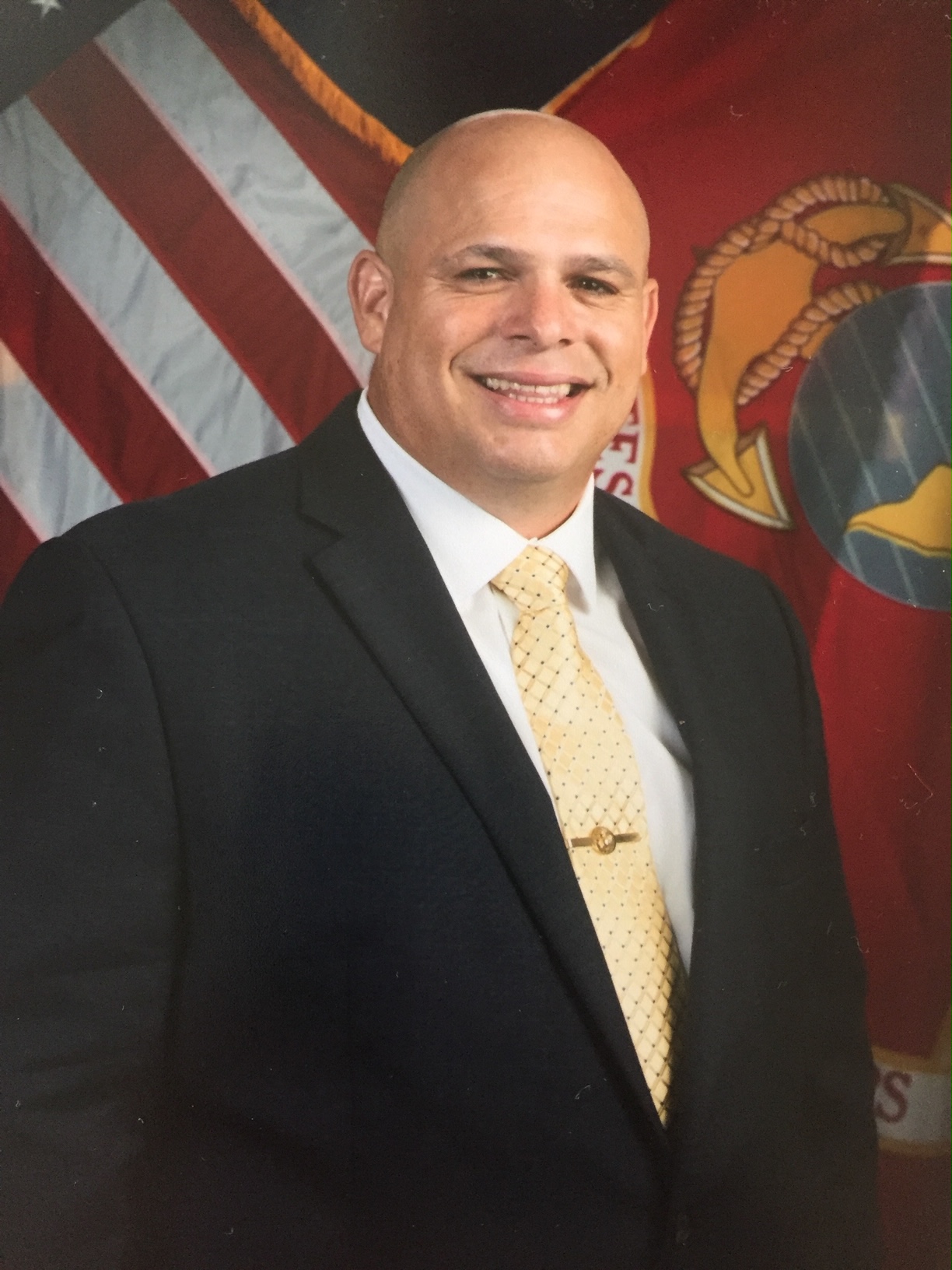
Antony D. Garcia is a native of Pueblo, Colorado, and a high-honors graduate of Smoky Valley High School in Lindsborg, Kansas. He attended the U.S. Naval Academy Preparatory School in Newport, Rhode Island, earned a SECNAV nomination, and entered the U.S. Naval Academy at Annapolis. Seventeen months in, he withdrew to care for his ailing father — a decision that defined his character long before his career defined his credentials.
What followed is thirty years in IT operations across three arenas — private industry, the U.S. military, and the federal civil service. The record reads less as tenure than as a sequence of distinct proofs.
(1) He earned his standards in uniform. He joined the United States Marine Corps in March 1992 and graduated boot camp at MCRD San Diego as Platoon Honor Man, with Meritorious Promotions to PFC and LCPL on the drill field. Named NCO of the Quarter at 9th Communications Battalion, 1st SRIG in 1996, he was honorably discharged in September 2000 after eight and a half years of service — the bulk of it forward-deployed in Okinawa, Japan.
(2) He led at enterprise scale as a federal supervisor. At DoDEA Pacific, he ran the enterprise infrastructure behind roughly 28,000 users across the Pacific theater — 55 schools, some 1,000 servers, a 75-person team. Later, as Deputy Director of IT Services at FNMOC, he carried a DISA JRSS migration through with zero unplanned outages and was recognized with the Navy Meritorious Civilian Service Award.
(3) He delivered a near-perfect security record under independent audit. Directing the network service center at a forward-deployed naval command in Iwakuni, Japan, his detachment scored 99.7% on the Traditional Physical Security Checklist — one component of the Command Cyber Readiness Inspection (CCRI) — the highest the senior auditor had seen in fifteen years at 10th Fleet Cyber Command. On every control within the detachment's span of authority: 100% compliance; the lone deduction was an inherited control outside that authority. He led that record with a small joint team he was proud to command — 18 Sailors, three Civil Service professionals, and two contractors.
(4) He turned a failing program around at scale. On a cloud-based PaaS under continuous monitoring, he lifted cybersecurity compliance from 55% to 98% in fifteen months — walking in to a failed Authority to Operate and walking out with a multi-year ATO.
(5) And the doctrine beneath all of it was forged earlier, in federal service. At the U.S. Department of Energy — under the mentorship of two seasoned mentors — he helped unify three overlapping federal enforcement regimes — spanning the bulk electric system, federal information systems, and federal internal controls — into a single program: the origin of the Hybrid Compliance Model that now runs through every volume of the series. His grounding in regulated environments reaches back further still, to healthcare IT and the discipline of protected patient-data systems.
(6) And today, he commands the operation the series documents. He founded TMG2S — TMG Global Service's managed web & security brand — and built the AI-integrated operation it runs on: defense-in-depth by default, infrastructure that heals what is safe to heal on its own, and a 24/7 watch he commands from anywhere — laptop or phone, across a coordinated, multi-machine footprint. It delivers what once required a team — enterprise-grade security, continuous compliance, and always-on availability — at a fraction of the conventional cost and headcount. That efficiency is not a shortcut; it is the thesis of the series, running in production.
The Work Today
Today, Mr. Garcia doesn't just document the operation — he runs it. Through TMG Global Service, Inc. and the managed web & security brand he founded, TMG2S, he keeps client operations always-on, secured, and watched — on an AI-integrated stack he engineered himself.
It runs on four capabilities. Bastion holds the walls — defense-in-depth built into every property by default, not bolted on after. Overwatch stands the watch — a 24/7 guard over site, inbox, and social presence that heals the known-and-reversible on its own, then reports what it did. Synthetic monitoring proves it — every customer-facing path is exercised end to end on a schedule, so a feature isn't "done" until its whole journey is verified working. And a mobile command center puts the entire watch in hand — commanded from anywhere, laptop or phone, across a coordinated multi-machine footprint.
Every piece runs under human command. The automation carries the load; a person still owns every consequential decision. The methods stay proprietary — the outcomes are the point: always-on availability, enterprise-grade security, and continuous monitoring, delivered at a fraction of the conventional cost and headcount. This is not a thesis awaiting a client. It is running now. Engage TMG2S to start the conversation.